Sunday, May 7, 2017

How Difficult Is It to Put Up a Tepee? (And Gaining Respect in the Process)

Engineering challenge: Put up a tepee with 15 sticks

We started off this challenge with 15 poles 
and a length of "sinew" (string).

After several minutes of attempts, there was a cacophony of "I need help, I need help!" heard around the room. Even as the students helped one another they were miserably unable to make a solid stand of poles for their buffalo hide coverings. 
(A perfect lesson in perseverance and grit - two of our favorite words at Seabury!)


So we got some advice from David and Charlotte Yue 
in their book, The Tipi A Center of Native American Life


The advice was to tie either three or four (depending on the tribe) poles together and make a sturdy tripod or quadpod (new word). Then lay the other poles on top of the solid foundation. 


We tried this and it worked much better. 
But it was still quite difficult. 


We then stretched our buffalo hide coverings over our poles.
We attached them using the modern day convenience called a glue gun.


And voila! Our Native American village, complete with bushes, canoes, fire pits, travoises, and drying racks. We even had an assortment of plains animals that visited our village.


 We learned (and experienced through our model making) that the Plains Native Americans were dependent on buffalo for survival. 

Here we are  determining what parts of the buffalo were used for food, clothing, shelter, tools, etc. 


The Natives Americans had great respect for nature as we learned in this book, The Buffalo Are Back by Jean Craighead George. The book was perfect for tying together some of our various science and social studies topics this year: conservation, plants, animals and Native Americans. 


Here's what the Scholastic website says about it:

We learned a lot about the word respect as we studied Native Americans and as we did this project.

From Merriam-Webster:
  • high or special regard :  esteem 
  • an act of giving particular attention :  consideration
  1. They were skilled, innovative engineers, able to build stable, weatherproof, transportable, beautiful homes from the natural resources available. We discovered this is not as easy as it looks and we esteem them!
  2. The Native Americans gave great attention and consideration to the world in which they lived, taking only what they needed and not wasting any of what they took. They held nature in high esteem as we can see by their ways of life. We hope to live in such a way that we, too, show great respect to the world we live in. 

Saturday, May 6, 2017

STEM Challenge: Build a Native American Home

Challenge: Can you build an accurate model of a Native American home with the "natural resources" provided?

First of all, we looked at lots of maps 
including some great National Geographic maps 
of "natives" from around the world.

We studied the geographic features of the various regions. 

We went on a nature hike gathering some natural resources.

We found an abundance of twigs, bark, fir cones, moss, little rocks and more. 

We divided into regional groups and came up with a plan to make the best use of our region's natural resources (plus some supplies from the MakerSpace.)

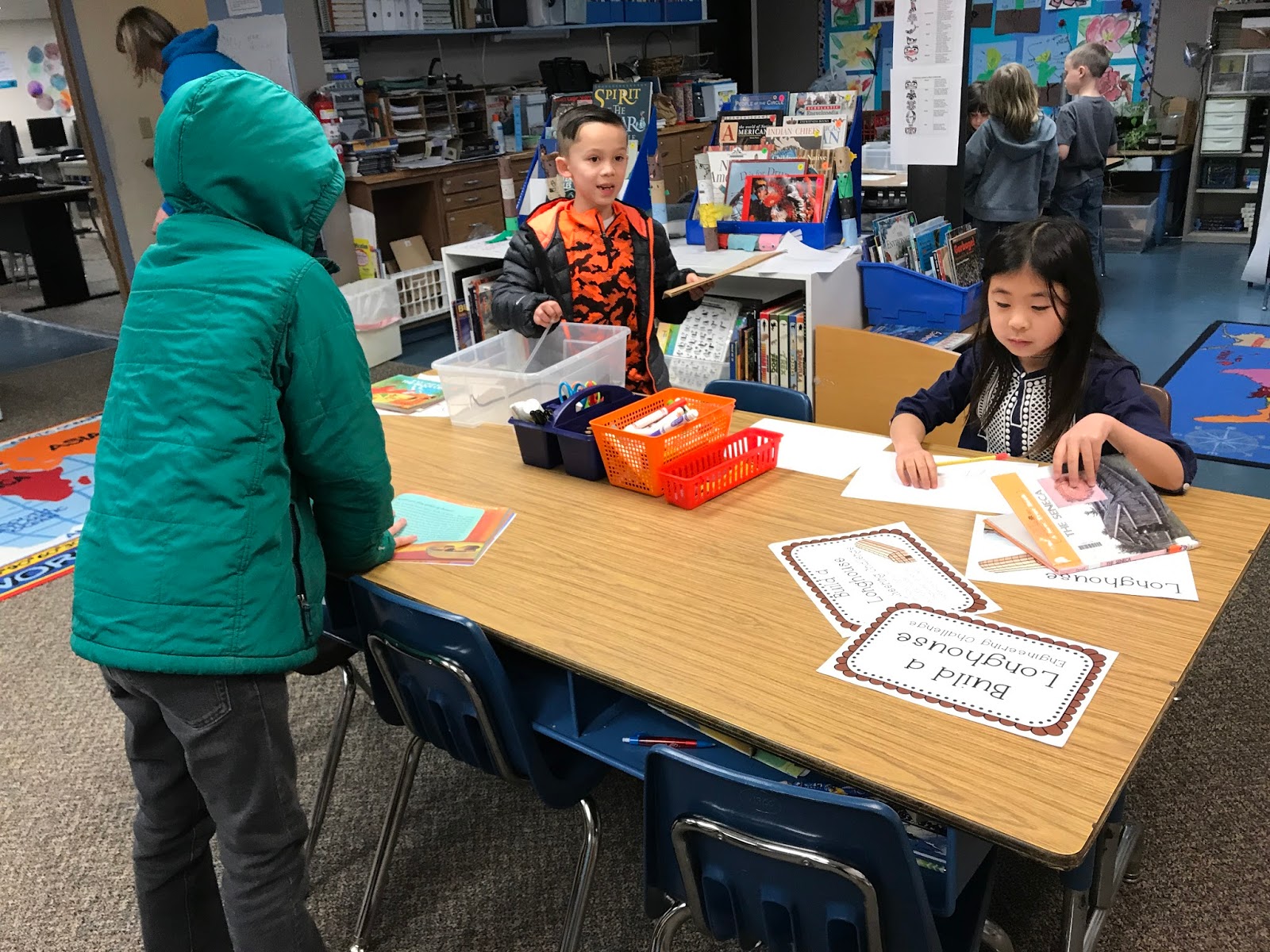
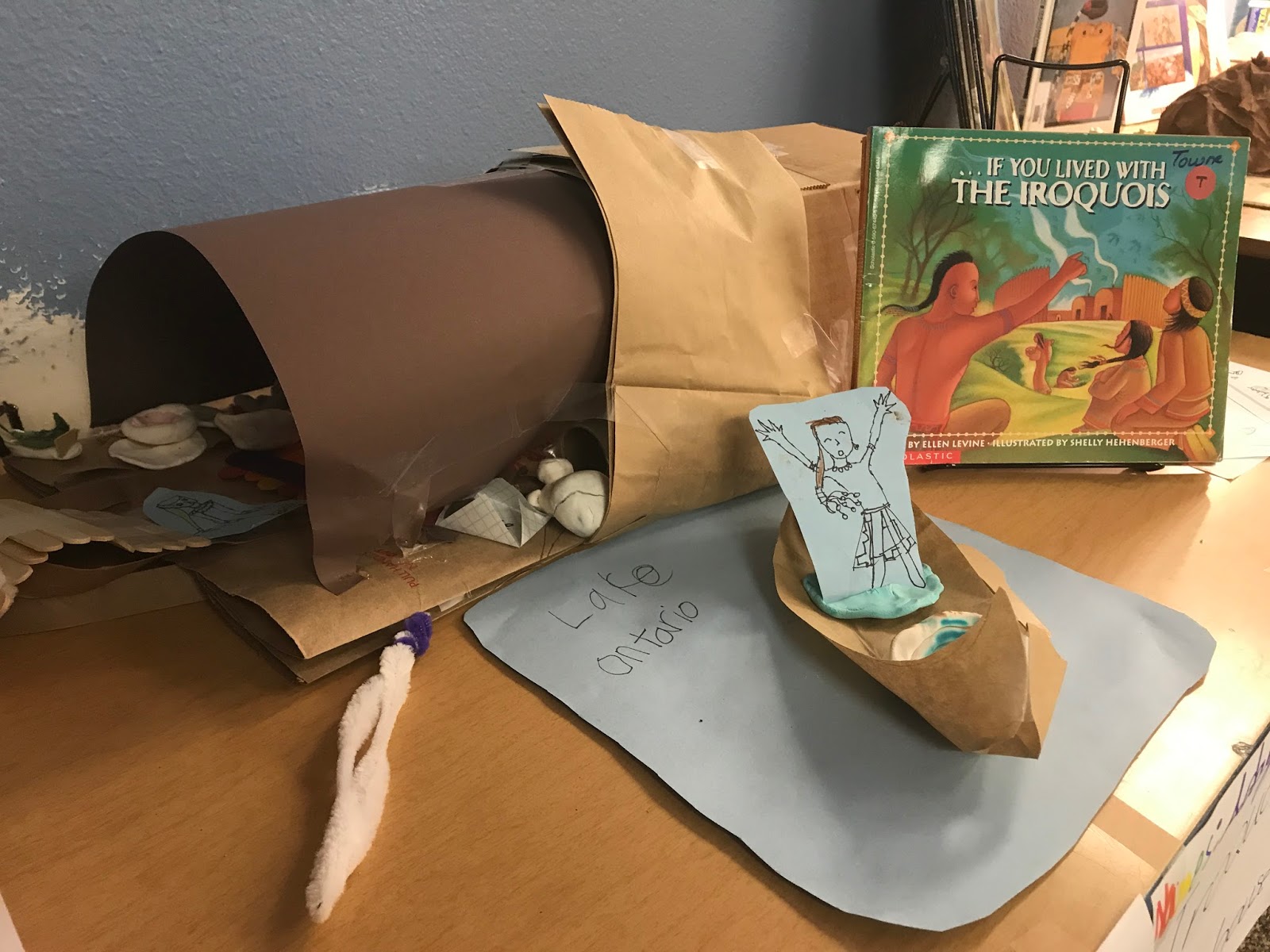
Can you build a longhouse like 
the northeastern Native Americans?

This group built the main elements of the building  using construction paper and brown paper bags. A longhouse could be up to 200 feet long and house an entire clan of 60 people. 
Teaching our friends what we discovered about our region
Inside and out, this longhouse met the standard. It looks accurate using the resources available!

Can you make a hogan like 
the southwestern Native Americans?

This group discovered that there are two different types of hogans,
one made out of  dirt and clay, the other made out of wood. 
Using dirt was not easy, but they engineered a way to accomplish the task. 
This is one made out of wood. It has a lot of pottery inside. 
Watch out for the lizards and scorpions living out in the dry desert. 

We learned about the many uses of maize, the "gift of the Indians." 
Can you make an igloo like the far north First Nations?

Making an igloo isn't as easy as you think! How does one get the walls to slant upward?
"Let's use this for the top!"

Here's the inside, warm and cozy.

An igloo could be built in half an hour. 
They were built small so that the body heat of the people would keep everyone warm.

Can you make a pueblo like 
the Navajo and Hopi Native Americans?

Pueblos are apartment type houses made out of adobe (clay and straw baked into hard bricks.)

Ladders were used to go from story to story. They could be pulled up to keep enemies out.
Notice the outdoor fireplace and the clay oven in this room.
The Navajo Native Americans are known for their pottery and weaving.
Can you make a wigwam like 
the eastern woodlands Native Americans?

This group used painted paper bags to look like bark. We talked about how the dome shape gave it great stability. Extended families--kids, parents and grandparents--all lived in this permanent/sometimes portable structure. 
Can you make a chickee like 
the southeastern Native Americans?

This platform house made of logs was the summer home for the Native Americans of the southeast. 

The bottom floor was raised about three feet to protect it from floods and animals. 
Can you make a plank house like 
the northwest coastal First Nations?

Using cedar tree "planks", this group built the walls first and then put them together. The coastal Native Americans/First Nations (Canada) were fishermen and so they were able to build permanent homes. They didn't need to follow the caribou for food like the inland clans. 

Notice the beautiful formline designs on this house and the carved totem pole in front of it.

Can you make a Native American tepee?


We all built a tepee (tipi, teepee). We had so much fun building and adding canoes, fireplaces, drying racks, etc., that an entire blog will be devoted to it.

Stay tuned....

We all had a great (and educational!) time engineering our homes, adding details, comparing and contrasting the different types of regions and homes. 

We also had time to PLAY! After a while, a bartering system began happening - trading supplies and sometimes trading with wampum. Of course, they had to put "friendly paint" on their faces first. 

All evidence that our many experience-based projects are making our study of Native Americans (and animals, plants, biomes, and conservation) come alive to these smart first and second graders! It's all coming together and making sense!! 

Sunday, April 30, 2017

At Home in the Forest: The Ohop Indian Village Experience

Ready? Set? Touch everything
(Except for the poisonous plants!)

Welcome to the Ohop Indian Village 
The Valley of the Sound of Rushing Water

The Navigators and the Gemstones went back in time before

Walmarts and Costcos
Electricity and running water
Iphones and Ipads

and learned how to survive and thrive 
as Native American Ohop children.
To the Native Americans, the forest was their home, their play ground, their school, their grocery store, their pharmacy, their lumber yard, their hardware store, their everything! No wonder they highly respected and took good care of it!

We had done a lot of reading and activities at school but there is nothing like rolling up your sleeves and experiencing it!

Pounding soaked cedar bark into soft fibers 

These soft fibers can then be twisted together into cordage and made into cloth.
Can you guess what this is? 
Answer at bottom of blog :) 

Making ornamental jewelry

 
A bentwood box like the one in the book Raven

In this trickster tale, the raven found the sun in a box and brought it back to his people. 

Tanning a deer hide

Making yarn out of bighorn sheep or goat wool

Giving weaving a try--over, under, over, under...

Trying on the what boys would wear.
Tule reed, wheat grass and and bear grass were all used to make clothing.
  
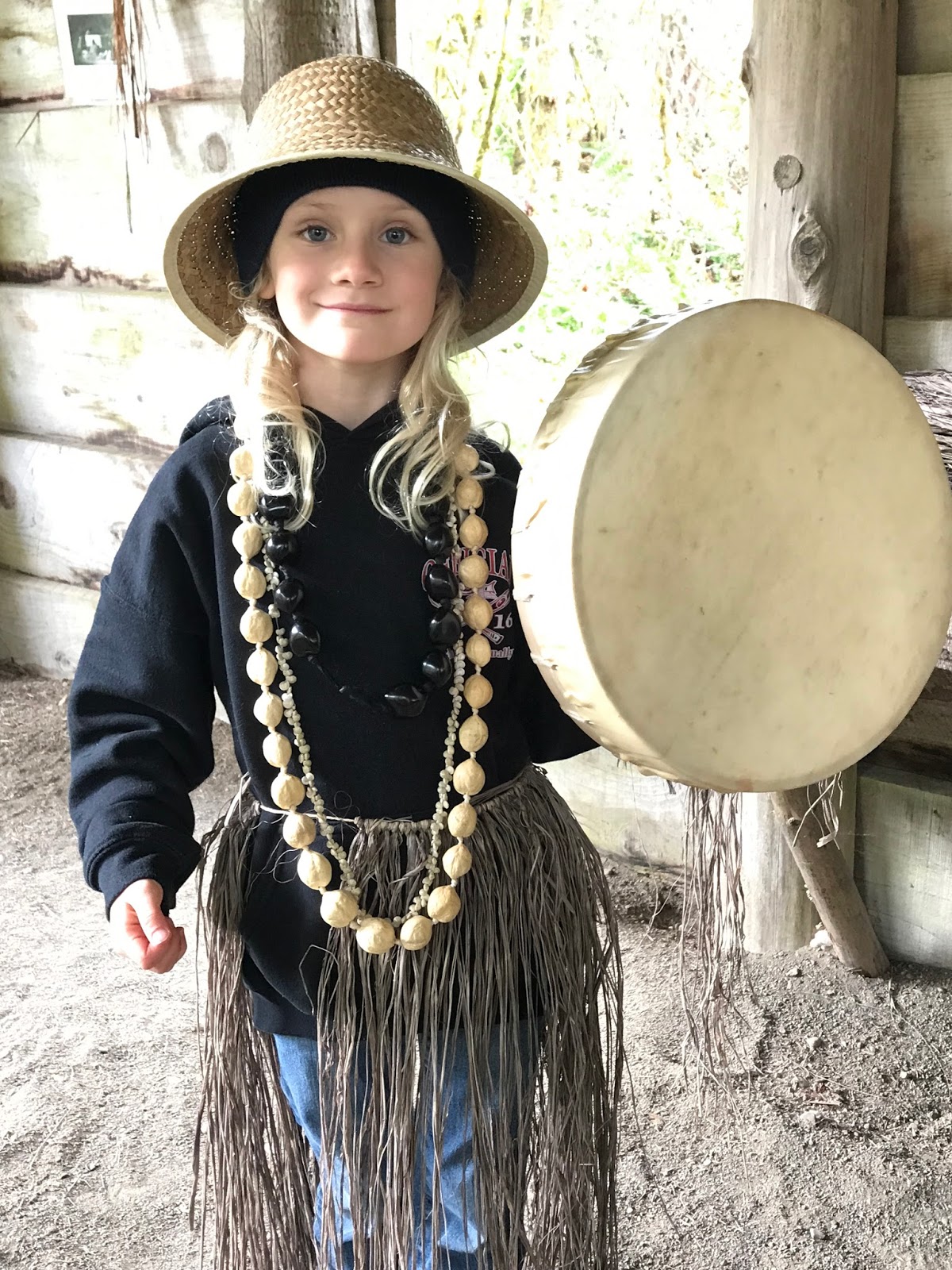
This student is part Cowlitz and she brought her own personal drum. 

A basket made from cattail reeds

This basket, called the Mount Rainier basket,  is made from bear grass, a light colored grass that dyes well. 
(We were asked to not touch this very old artifact.)

A shirt made from grasses

Making our mark for the future--a harbor seal petroglyph

 
Play is an important part of a Native American child.
It is a way to learn the skills necessary for survival.

A spontaneous group game of ring toss

Spear throwing practice

Sharpening a slate arrowhead

Learning how to be still, aim and hit a target

How did I do?

Ironwood is good for nails, staffs and arrows because it is straight and strong.

Ironwood also resists heat and is good for picking up hot rocks. 
The hot rocks are used to boil water.

 
A stick, a rock, and a bone make a fine working drill.

Various types of canoes for various types of uses
  
Hollowing out a future canoe 
  
Making music on a plank drum
They called their group "Native Awesome."

Ready for part 2 of our trip
The native plant nature hike
  
The shaman was an expert on all plants.
But each person was responsible for developing their own "special eye"
for a specific plant
so that they could look at a plant and know if it was good or bad. 
This was a way to keep the community 
 healthy and safe.

She taught us about plants that are beneficial for diarrhea and for upset stomach, 
plants that stimulate appetite and plants that suppress it,
plants that are edible and full of good vitamins and plants that are poisonous,
plants that sting us (stinging nettle) and plants that take the sting away (fern)
and much more.

False Solomon's Seal
A powerful narcotic pain reliever


Trillium--a time teller
Goes from white to pink to purple throughout the season
 
The cedar tree--the "tree of life" for Pacific Northwest Native Americans
This tree is over 250 feet tall and is therefore over 250 years old.

One Navigator expresses our feelings best!

Answer to the "what is it" question:


Put some some moss or animal fur in the center


Attach it to baby


and voila


A DIAPER!