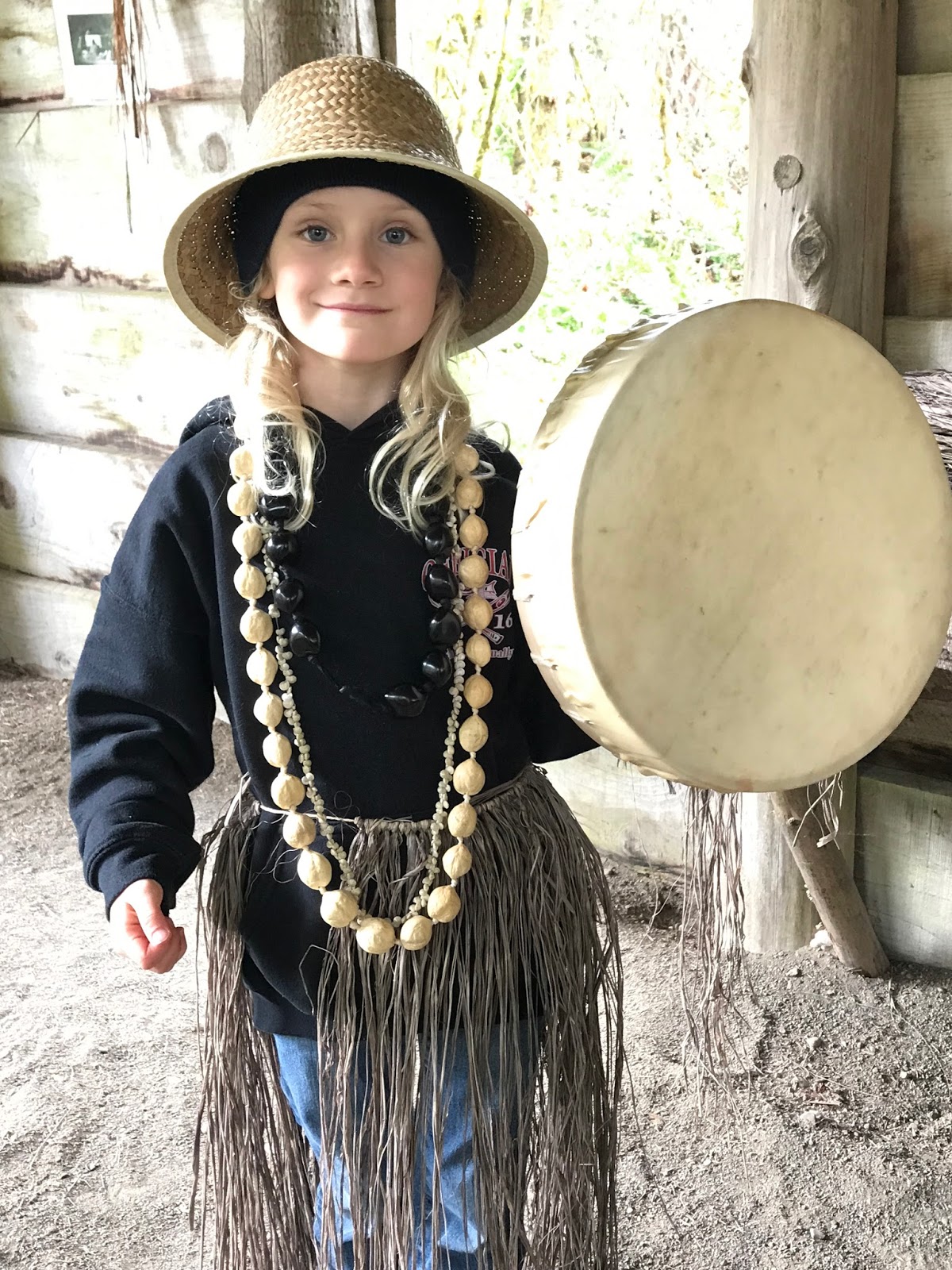
Challenge: Can you build an accurate model of a Native American home with the "natural resources" provided?

First of all, we looked at lots of maps
including some great National Geographic maps
of "natives" from around the world.

We studied the geographic features of the various regions.

We went on a nature hike gathering some natural resources.

We found an abundance of twigs, bark, fir cones, moss, little rocks and more.
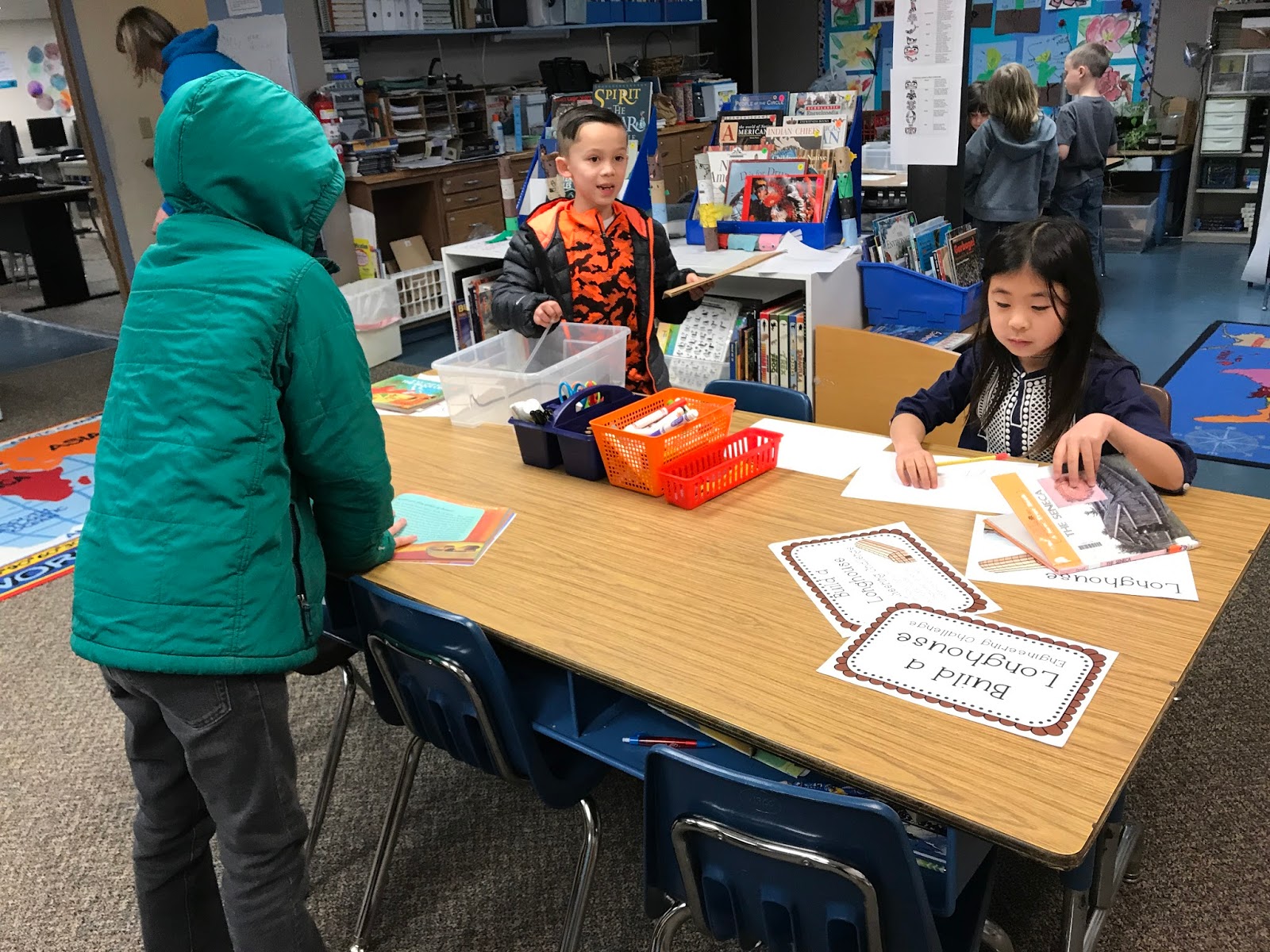 |
| We divided into regional groups and came up with a plan to make the best use of our region's natural resources (plus some supplies from the MakerSpace.) |
Can you build a longhouse like
the northeastern Native Americans?
 |
| This group built the main elements of the building using construction paper and brown paper bags. A longhouse could be up to 200 feet long and house an entire clan of 60 people. |
 |
| Teaching our friends what we discovered about our region |
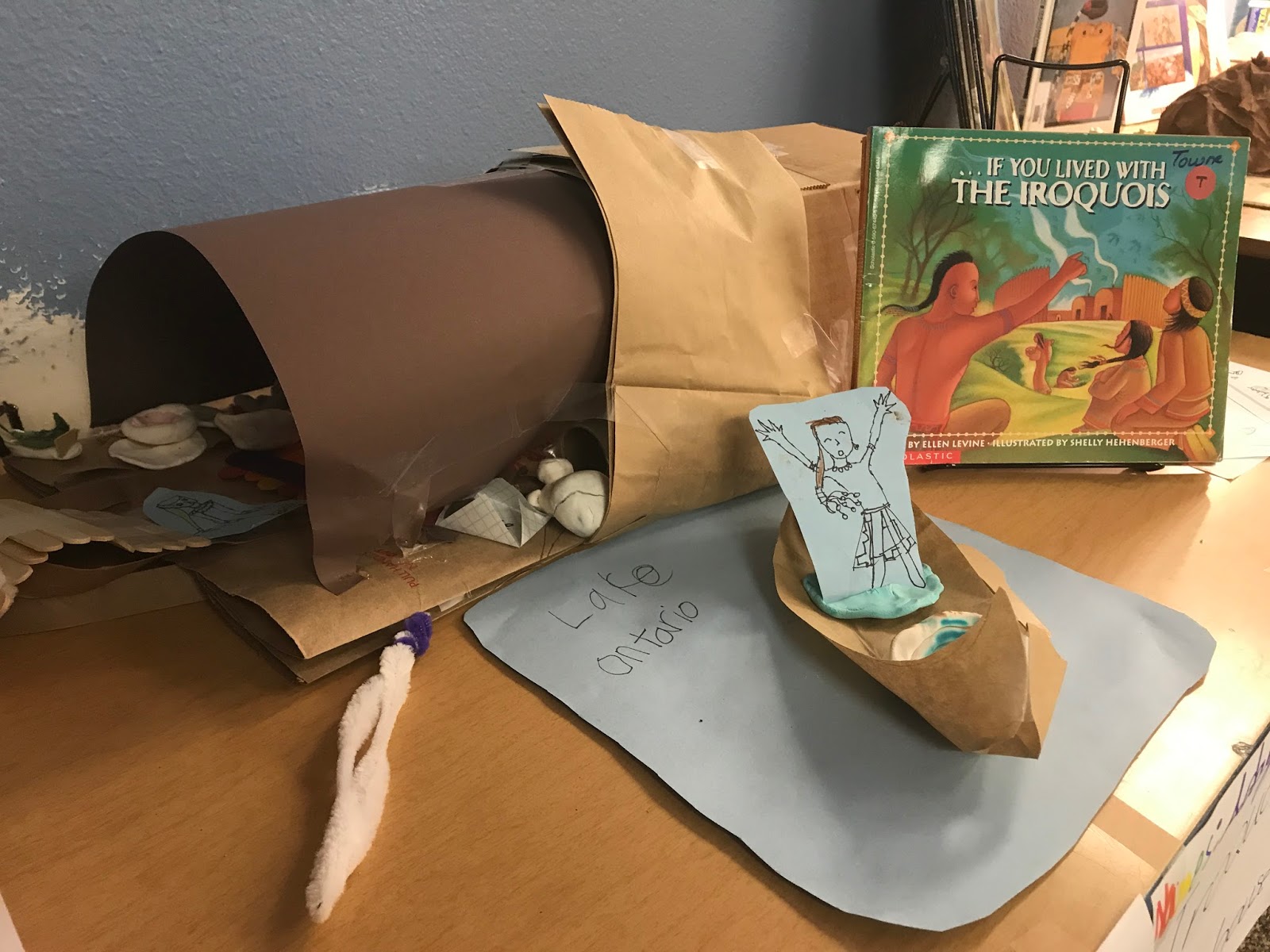 |
| Inside and out, this longhouse met the standard. It looks accurate using the resources available! |
Can you make a hogan like
the southwestern Native Americans?
 |
| This group discovered that there are two different types of hogans, one made out of dirt and clay, the other made out of wood. |
 |
| Using dirt was not easy, but they engineered a way to accomplish the task. |
 |
| This is one made out of wood. It has a lot of pottery inside. |

Watch out for the lizards and scorpions living out in the dry desert.
 |
| We learned about the many uses of maize, the "gift of the Indians." |
Can you make an igloo like the far north First Nations?
 |
| Making an igloo isn't as easy as you think! How does one get the walls to slant upward? |

"Let's use this for the top!"

Here's the inside, warm and cozy.

An igloo could be built in half an hour.
They were built small so that the body heat of the people would keep everyone warm.
Can you make a pueblo like
the Navajo and Hopi Native Americans?
 |
| Pueblos are apartment type houses made out of adobe (clay and straw baked into hard bricks.) |
 |
| Ladders were used to go from story to story. They could be pulled up to keep enemies out. Notice the outdoor fireplace and the clay oven in this room. |
 |
| The Navajo Native Americans are known for their pottery and weaving. |
Can you make a wigwam like
the eastern woodlands Native Americans?
 |
| This group used painted paper bags to look like bark. We talked about how the dome shape gave it great stability. Extended families--kids, parents and grandparents--all lived in this permanent/sometimes portable structure. |
Can you make a chickee like
the southeastern Native Americans?
 |
| This platform house made of logs was the summer home for the Native Americans of the southeast. |
 |
| The bottom floor was raised about three feet to protect it from floods and animals. |
Can you make a plank house like
the northwest coastal First Nations?

Using cedar tree "planks", this group built the walls first and then put them together. The coastal Native Americans/First Nations (Canada) were fishermen and so they were able to build permanent homes. They didn't need to follow the caribou for food like the inland clans.

Notice the beautiful formline designs on this house and the carved totem pole in front of it.
Can you make a Native American tepee?

We all built a tepee (tipi, teepee). We had so much fun building and adding canoes, fireplaces, drying racks, etc., that an entire blog will be devoted to it.
Stay tuned....
We all had a great (and educational!) time engineering our homes, adding details, comparing and contrasting the different types of regions and homes.
We also had time to PLAY! After a while, a bartering system began happening - trading supplies and sometimes trading with wampum. Of course, they had to put "friendly paint" on their faces first.
All evidence that our many experience-based projects are making our study of Native Americans (and animals, plants, biomes, and conservation) come alive to these smart first and second graders! It's all coming together and making sense!!