Saturday, April 8, 2017

Arbor + Etum = Place of Trees

On the first day of spring we had a fun, learning, wet time at the Washington Park Arboretum/University of Washington Botanical Gardens.  What a great way to expand on our study of plants. 

Here are some pictures of our trip.


A Latin lesson

An apiary! We're especially interested in bees. 


One of our favorite book series

Lots of native and non-native trees

An up close look


These walkers helped us with our scavenger hunt. 

We've set a record for rainfall this year and we could tell!

Helping to pollinate the hellebores. 


We learned about native trees and how Native Americans used them. 

A plank house wall


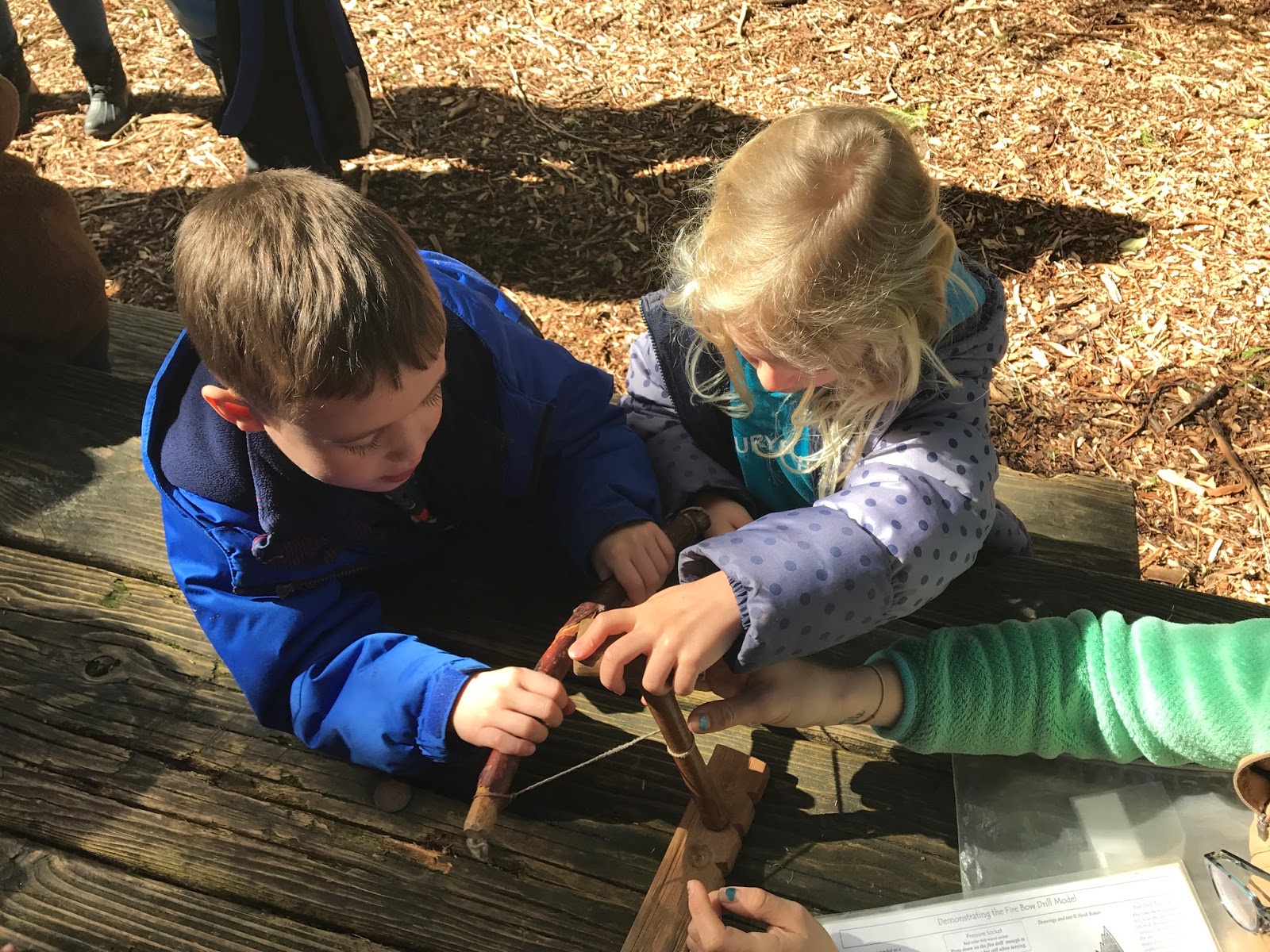
Making a fire

The sun came out for us on this first day of spring. We're all about hands-on learning and we can't wait to get into dirt up to our elbows! More to come....


Saturday, April 1, 2017

The First Annual Seabury Navigators Stop Motion Film Festival

The Seabury School First Grade Navigators made stop motion films as a culminating activity for our study of animals.

And here they are!

The Two Big Wolves (click on the title)

Featuring Sassy and Robin
Set in a forest
In this film the people are afraid of the big wolves but discover that they are not so bad after all.

The Vegetarian Anaconda and the Meat Eating Komodo Dragon (click on the title)

Featuring Sneaky the Snake and Kodo the Komodo Dragon
Set on a rain forest island
These two animals have a problem--they don't like to eat the same thing! Watch and see what happens when they come up with a solution. 

Eaglets in Danger (click on the title)

Featuring John the Eagle and Nina the Giraffe
Set in the savanna and the forest
Oh, no! The wolves come through an animal portal and take the eaglets! What are John the Eagle and Nina the Giraffe going to do!?

The Thunder Shock (click on the title)

Featuring Shell the Snail and Rainbow the Macaw
Set in the rain forest section of a zoo
What do you do when a storm comes and the habitat of the animals is destroyed? Get ready for an interesting twist in this very "sweet" story. 

Here are the steps we took:
  • We went to the Seattle Children's Film Festival and got inspired.
  • We watched several stop motion films including a Gumby and Pokey one and looked for the beginning, the middle and the end of the stories.
  • We made a film together, Help Our Planet (click on the title), to get an idea of how the "Stop Motion Studio" app worked.
  • We came up with our own characters--usually our favorite animal. 
  • We teamed up with a partner.
  • We made our characters and our scenes.

  • We came up with a story and made a storyboard that included 
    • the beginning (introduction of characters, setting, problem or situation introduction)
    • the middle (what we call the "oh, oh's"--how the problem plays out)
    • the end (the resolution of the problem and the conclusion)

  • We started filming.
  • We added sounds and music.
  • And we waited excitedly for the First Annual Seabury Navigators Stop Motion Film Festival!
  • On March 31, we invited our parents and the entire lower school to the First Annual Seabury Navigators Stop Motion Film Festival. 
  • The Festival was a hit and we received rave reviews!


Sunday, March 26, 2017

3.14, Pi Day!

The concept of pi is not an easy one for young students, but since we've been studying the perimeter and area of rectangles, why not take a look at the perimeter and the area of a circle?


We started with a question: How does one measure the perimeter and the area of a circle? We decided that it's easy to measure the perimeter with a string and then measure the string.

But what about the area? The curves of the circle make it a lot more tricky!

So, we went back in time, to the days of King Arthur, knights, castles and dragons, to the land of Sir Cumference, Lady Di of Ameter and their son, Radius.


In this math adventure book, The Dragon of Pi, a potion has turned Sir Cumference into a fire breathing dragon! His son Radius goes on a quest to solve the riddle and save his father and the kingdom from ruin!

Can you solve the riddle?

     Measure the middle and circle around,
     Divide so a number can be found. 
     Every circle, great and small -
     The number is the same for all.
     It's also the dose, so be clever,
     Or a dragon he will stay forever. 

So we set to work, measuring around, across and dividing...


...and we discovered the number is always almost the same: 3.14! Pi!

We also learned an important formula that is sure to come in handy some day:

Circumference divided by diameter equals PI

or 

C ÷ D = Ï€

Oh, and SPOILER ALERT...Radius solves the riddle just in time and saves his father and the kingdom! Huzzah!!

Now we want to read ALL these books by Cindy Neuschwander!


Friday, March 24, 2017

Beaks and Feathers and Audubon, Oh My!

As a life-long bird watcher myself (thanks to my mom!) I could teach about birds all year long and never run out of things to do. But since that's not possible, I'll include a list of things to do and places to go in the Puget Sound area so that you and your child can learn more and perhaps become life-long birders as well.

Here are some of the things we did in class:

BEAKS

We played a game called "Busy Beaks" in which we were given one minute to to pick up a variety of "food" with a variety of "beaks". We discovered that different types of birds have different types of beaks that eat different types of food.

The "food" included seeds/cheerios, pipe-cleaners, jelly beans and raisins.
The "beaks" included spoons, toothpicks, tweezers and clothespins.


We recorded our findings. 

We made graphs using  Create-a-Graph.  Notice the labels each student chose to use.


FEATHERS

We looked at feathers up close under a microscope.

Lots of oohs and ahs.

We read a book about feathers and learned about the different types and purposes of feathers. 


We personalized a readers theater script called "Feathers."

We made our own costumes in the MakerSpace. 

A swan:

A red-tailed hawk

We practiced and practiced and then presented our readers theater to our schoolmates at Gathering. 
Not the best picture, but notice the sled for a penguin and the snowshoes for the ptarmigan. We learned a lot about feathers and came up with some great ways to show our friends.  

She was also a peacock.

JOHN JAMES AUDUBON

We learned about a boy with a passion, John James Audubon.


We watercolor painted our own birds (and did a mighty fine job, I might add.)


Other things to do in the Puget Sound area:

Get a bird book and keep it in your glove box! And keep an ongoing list. Or start a contest to see who can have the longest list.

Bird Cams:

Local Browns Point eagle nest:
Walk down Varco Road. It's almost at the end of the road. Be respectful of neighbors and stay on the road.

Annual Migration
May 5-7, 2017
from the webpage: 
Each spring, hundreds of thousands of shorebirds stop to rest and feed along the Washington Coast and in the Grays Harbor estuary during their migration northward. Coming from as far south as Argentina, these Arctic-bound shorebirds are among the world's greatest migrants. Some birds travel over 15,000 miles round trip! The concentration of birds during spring migration offers people a great chance to view a number of shorebird species. With luck you will also see the birds fly together in beautiful formations while trying to escape a Peregrine Falcon.

There is also a great local Coastal Interpretive Center on the tip of the Ocean Shores peninsula.

Heron Rookery in Renton
from the webpage:
The Black River Riparian Forest and Wetland is home to more than 50 species of birds, including one of the largest great blue heron colonies in the region. The site is a complex ecosystem with an abundant wildlife habitat. The Black River Riparian Forest and Wetland is a year-round bird watcher's paradise and provides an oasis and a unique view of nature within Renton's city limits.

Other bird spotting locations:
  • Point Defiance Park Outer Loop
  • Commencement Bay Trail
  • Wapato Lake Trail
  • Titlow Park
  • Owen Beach Trail
  • Bresemann Forest Trail
  • Snake Lake Loop Trail--great place for wood ducks
  • War Memorial Park to Tacoma Narrows Bridge  

Others:
  • Weyerhauser headquarters has great trails (just pretend that the sound of I-5 is the ocean)
  • Hylebos Park in Federal Way
  • Mount Rainier
  • Nisqually National Wildlife Refuge
  • Olympic National Park area (I saw an albino robin there once!)
Tahoma Audubon: Lots of good resources including the Adriana Hess Aububon Center, monthly classes and activities, an art contest (http://www.tahomaaudubon.org/kids), field trips and more.

It Starts With a Question: How Do Birds Fly?

How do birds fly? That was the science question we set out to answer as we studied animals.   

In order to find out the answer, we went through the Scientific Process of asking questions, observing, experimenting, hypothesizing, more experimenting, and concluding--all things that kids so naturally do. 

We had all kinds of "I think" answers:
  • wind
  • air
  • their feathers
  • flapping wings
  • the sun
  • the Equator, no I mean the magnetic field

We then did some observations and "I wonder if..." experiments:

Each student was given a piece of paper and were told to make it fly. We knew that there was a way to make a paper airplane but no one knew how (and their teacher wouldn't show them!) There was great determination, experimentation, excitement and even some angst over trying to make it work. 

We read the book, Leonardo and the Flying Boy and discovered that we're not the only ones who believe in flight!


We came back the next day eager to get “back to the drawing board” and try new designs. And we had success!


We knew we could make paper fly but we still didn't quite get the why. So we did some experiments that showed the Bernoulli's Effect. And we were greatly surprised.

We wonder what will happen when we blow underneath a strip of paper:

We observe that it blows straight out. We wonder what will happen when we blow over the strip of paper? We hypothesize that it will go down. 
What?? We observe that it blows straight out again!
Click here to see. 

We wonder what will happen when we blow between two balloons? We all think the balloons will blow apart.
But no! We observe that the balloons come together every single time!

We try something new. What do we think will happen when we blow through a straw right next to a flame? We all think the flame will either be blown out or will move away from the stream of air.
But no! We observe that the flame moves toward the blowing air!

Why do we think this is happening?

This led to some great discussion and some great ideas. As we listened to each other and as we looked at an airplane wing and a bird's wing, we came pretty close to the correct answer. 

We then watched a video on how a bird flies and had a few more aha moments. 

Ask any Navigator what the Bernoulli's Effect is and you'll find out more!