Wednesday, February 8, 2017

How Do Fish (and People) Float? A Scientific Yet Practical Lesson in Swimming

How do fish float? Here are some of our preliminary ideas:


I think:

  • it's because of the oxygen in their body and their light bone mass
  • the gills help them move because the gills give them energy
  • the water keeps them up
  • they float with their flippers
  • its their flippers. We float because we have two arms
  • because of their flippers
  • the fins and tail move side to side

I wonder: 

As we take our annual swim lessons, we get to experiment with floating and with using our "fins, flippers and tails."
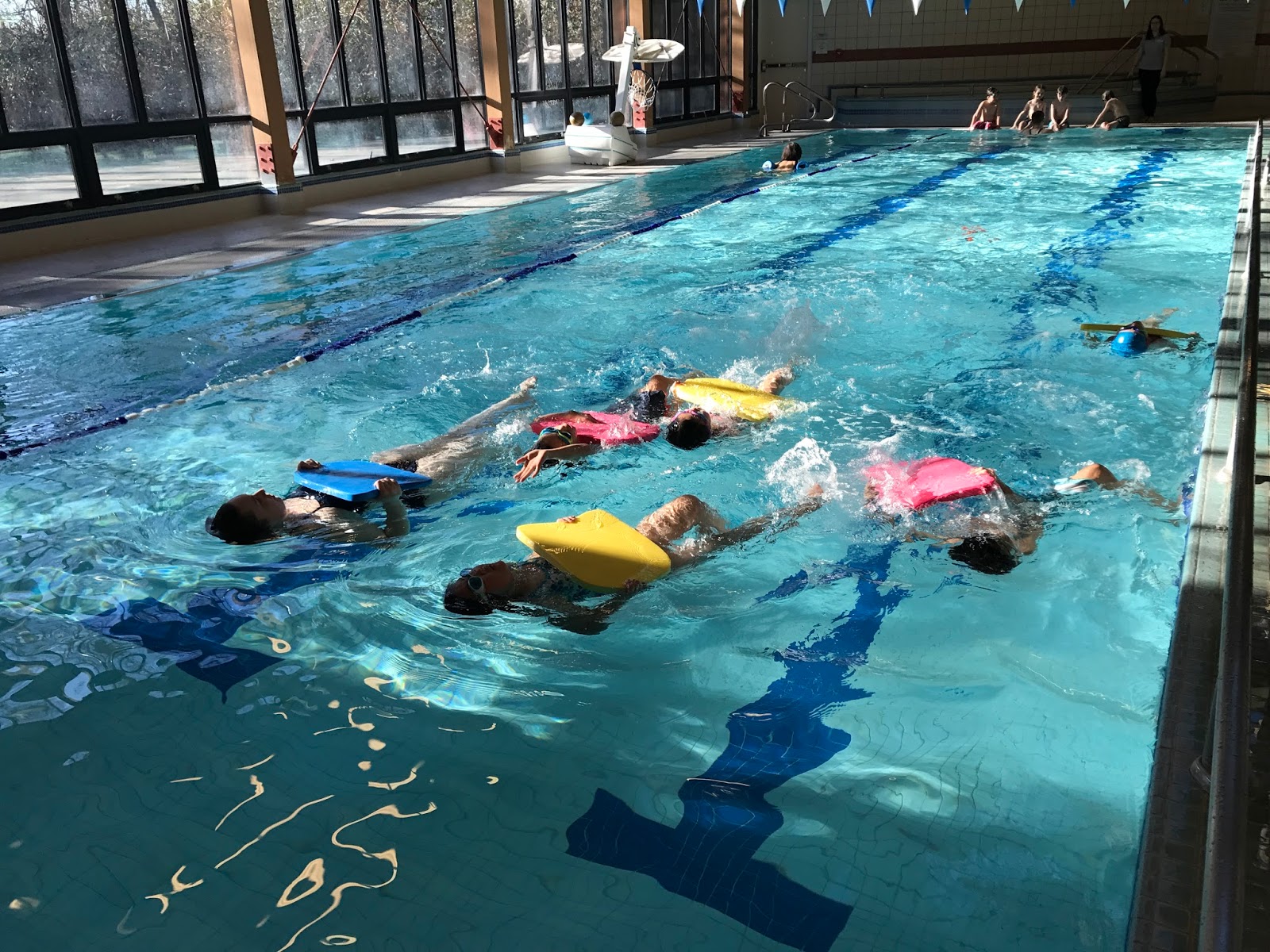
Our boards help us float

Breathing and filling up our lungs
I can float on my back!
Adding some "tail and fin" action
Put it all together and we're fish, floating and swimming!
And we're happy fishies!!

I wonder:

Back in our classroom, we predict what will float and what will sink. We begin to use the scientific term buoyancy. After all, we are scientists!

We get some water and start experimenting.
Rocks, shells, buttons (with holes,) and other things "full of stuff" are not buoyant.

Feathers, straws (that are empty,) clothespins, corks, 
and other things that are flat and "not full of stuff" are buoyant!

We try making a ship that will hold a large load much like the container ships we see out in Puget Sound.
How many pennies will it hold?
 What if I turn up the sides?
My ship needs a gang plank so the sailors can get to shore easily.
I know! Popsicle sticks float! Let's add a bunch of popsicle sticks. 
A true Seabury Kid--I think, I wonder, I'll try, I discover
The Seabury Navigators, in true scientific process form, discovered several principles of buoyancy:

What makes something float in water? Anything lighter than water. 

Things "full of stuff" have more mass and aren't buoyant.

A fish has an air filled space in its body called a fish bladder that can fill up or lessen depending on whether the fish needs to go up or down in the water. 

Archimedes' principle: the buoyant force on an object is equal to the weight of the fluid displaced by the object.

As long as the water our bodies displace weighs more than we do, we float. We weigh less than the water we're in because our lungs are full of air. We float like a balloon!

Monday, February 6, 2017

Taxonomy, the Classification of Living Things...and Shoes!

Always thinking like scientists, the Navigators began our study of animals by learning how to classify living things. We did this by sorting our shoes. We started out by splitting them into two of the most obvious groups--the laces and the non-laces. We then continued to observe and divide until each shoe had a specific name--the genus species of the shoe. 

We see:
We observed many things such as how shoes stay on our feet, the colors, the materials, the brand names, the decorations, the soles, even the cleanliness (we decided to not sort by that one since that one changes and is not part of the actual shoes) 
Very serious business

So many types

So many details

We wonder:
Since we figured out a way to classify shoes, we wondered how scientists divide animals into different groups. 

We were given groups of animals and began to sort by animal attributes. 

One group sorted by types of appendages.

Another sorted by number of appendages.

This group measured the animals.

Writing the branches of long nose and short nose

Each group came up with a genus species for each animal.

Each group came up with a different way of sorting.
We talked about the good parts and the not-so-good parts of how each group sorted. 

We continue to wonder:
Why did we have differences in how we classified our animals?
How do scientists classify animals?
Why would it be important to have a standard way to classify animals?

We discover:
We discovered that in the 1700's, (around the time of some our explorers they noticed!), a man named Karl Linnaeus came up a system of classification that is still used today by scientists around the world. 


We discovered that the official, world-wide language of science is Latin. 

We have much more to discover about animalia but now that we homo sapiens can now speak some Latin, we're ready to go for it!


Saturday, February 4, 2017

Hats for All--Experiencing Tea With a Teacher

One of my favorite things to do as a Seabury teacher is to put a teacher experience up for auction at our annual Seabury Auction. This year's (2016) experience was a Tea Party with Mrs. Towne. Two families won the auction and so I was able to make memories for and with two groups of students. 

The first tea was held at my house.


The hostess of the first group. She's got the pinkie finger thing down!


The second tea was held at the very fancy 
Olive Branch Cafe in Tacoma.

The hostess of this party of older students. It's so fun to reconnect with former students!
She's been a hostess before--three years ago.


Caps For Sale, a childhood favorite of the girls. "Tsz, tsz, tsz!"

Sunday, January 29, 2017

"Conservation Through Education" The Cougar Mountain Zoo

 
"The cougar (Puma concolor), also commonly known as the mountain lionpumapanther, or catamount, is a large felid of the subfamily Felinae native to the Americas." ~Wikipedia

In our study of animals, the Navigators and the Gemstones, have been learning about how and why scientists classify animals and about how and why we "treasure" these "treasures" (our overarching theme of the year.) 

When we choose where to go on our field trips, Mrs. Maitlen and I do our research and look for the biggest bang for our buck. Although neither of us had been to the Cougar Mountain Zoo, there were several things that caught our attention. And we were not disappointed! We had a great time and came home inspired and a bit wet. 

Here is a list of reasons we chose this zoo in no particular order:

Reason #1: Lots of up close encounters. 

Reason #2: It has cougars! Seabury is close to the Point Defiance Zoo so we decided to go somewhere new and different.

Reason #3: "A living classroom"
There are many well-informed, passionate volunteers to tell us about the animals.  


Reason #4: We always have fun with our friends!

Reason #5: When do you ever get to be close enough to a white Bengal tiger that there are warnings that you might get sprayed? 

 
Reason #6: It is a small, locally owned zoo. With the forecast of torrential rain, we had the place to ourselves. (Fortunately, the sun peeked through for most of our visit!)


Reason #7: It has the largest bronze animal zoo art collection of any zoo in the world.

Reason #8: It "represents a greenbelt in a the sea of development of the Puget Sound Region."
The wolves overlook the Issaquah Valley, Lake Sammamish, and I-405. 


Reason #9: It "educates and encourages thousands of zoo visitors to give to wildlife conservation."

Reason #10: We learn to respect wildlife. 
Here we are just pretending to howl like the nearby wolves. 

Reason #11: The zoo has many endangered species including this varecia variegata rubra!

Reason #12: The zoo is always improving. 
This home for the red-ruffed lemur will be renovated soon. 

Reason #12: No child left inside--outside lunch!

 
Reason #13: We get to pose by our favorite animals.


Reason #14: There is always something amazing and wonderful at a zoo!


Reason #15: The animals want to see us, too! (Notice the bird in the background begging for attention!)