Friday, March 28, 2014

February/March: The Amazing Human Body

Over the past few months we have been learning about the human body. We've made models, watched videos, had guest speakers (thank you moms, dads and grandmas!), done experiments, dissected organs, gone on field trips, done extra research and much more. Even in PE we've been learning about the proper care of our bodies through exercise and eating well. During a recent cardiologist's visit the students made interesting observations and asked very astute questions: 

"What do you like about your job?"
"How many people have you saved?"
"It looks like a very scary branch!" (When looking at the arteries of the heart.)
"That's so cool!" (When seeing a stint on an x-ray that saved a person's life.)
"Your job is like doing video games!" (When Dr. Guerra told us how he does heart surgery by looking at a screen.)


Acting out the circulatory system

Dr. Guerra, a cardiologist, telling us about his work 

 
The Navigators and Explorers shared their 
human body models and what they have learned with the whole school.

We had fun making our models.
Siri let us know that a child's small intestine is 20 feet long. 
So, how long is 20 feet? 

Stuffing our guts! 

The Navigators at the end of a science-filled day of school

We had fun designing our own stethoscopes.
This stethoscope doubles as a horn.

Chris Buchanan, a speech therapist,
telling us about speech and hearing 

A model of the ear canal

The ear dream magnifies the sound!

Our eyes work together (using an antique stereoscope)

Bodyology in Bellevue
One of the Navigators is up on stage using her muscles in a unique way!

Fun with friends at Meydenbauer Center in Bellevue

Taste testing with Dr. Coffee, a taste specialist and professor at Clemson University

Tasting sweet, sour, salty and bitter

A brave taster

Thinking...

Not so pleasant

Do I have to?

You go first.
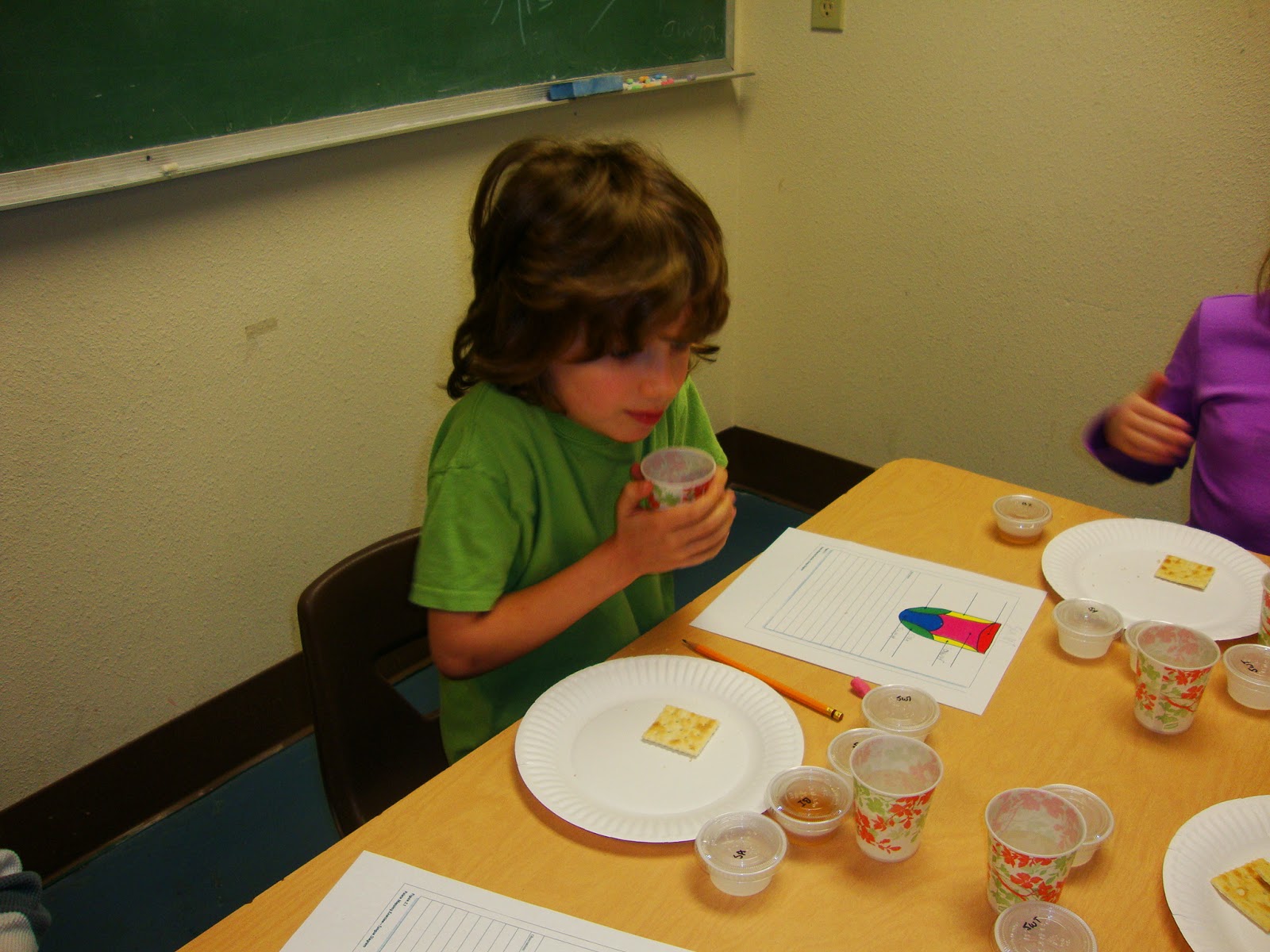
Not so sure

Very sure!


Sunday, March 23, 2014

March 19, 2014 GPS Mapping at West Hylebos Wetlands Park

 The Navigators and Explorers became Cartographers this week with the help of Lester Power, one of our dads and a mapping scientist at Weyerhaeuser. We divided into groups, held our GPS devices up towards the satellites in the sky and walked the trails of West Hylebos Wetlands Park marking important waypoints along the way.


Here's the amazing composite map we made of the park.
(POI = point of interest. We had many of those!)

And here it is compared to the brochure we picked up at the park. It's almost the same!

Here's how we did it.
We made the trip to West Hylebos Wetlands Park,
a sanctuary in the middle of Federal Way, Washington
about ten minutes from our school.

Getting equipped
Clipboard and pencils? Check.

Outline map? Check.


Satellite map? Check.

Rite in the Rain paper to record waypoints? Check. 
Notebook? Check.

Rain? Check.


And we're off to explore, navigate and map the beautiful and wet wetlands!
Waypoints along the path that we programmed into our GPS devices:
Interesting trees

Skunk cabbage

Fungi

The Deep Sink

The sign of the beaver? The turtle?
Bridges

Gadgets are us!


Wrapping it up back at school:

Group C's map was quite accurate.
 Studying our maps:


We ended the day with beautiful sunshine. Mr. Power took us outside and showed us how it takes four satellites to get an accurate GPS location.

We're so grateful to have such supportive and interesting parents that are willing to come in and share their skills and passions with us. Thank you, Mr. Power! 


March 6, 2014 Field Trip: Slater Museum of Natural History

The Navigators, along with our Explorer friends, attended the Slater Museum of Natural History. With sketch journals in hand, we were ready to see the "well-curated collection of specimens" and to  join in the "research and education by the communities to which it belongs: the University of Puget Sound, the Puget Sound region, and, in a broad sense, the world." THAT'S US!


For more pictures of the fur fridge, the collections of preserved amphibians and crossbills, various eggs and  much more, be sure to check out the Explorers' blog:  Field Trip: Slater Natural History Museum